
- 11 – St. John Stone
- Rachille Lusbog
- Kaye Clarice Jaim
- Maricris Sophie Mercado
- Faye Villarta
We, The Group 5, is for the citizens, who must know the responsibility and want to be oriented,discipline, and know its possibilities of this issue. The Group 5 is unlike the current government officials because it focuses more on peoples attitude and discipline like it start with the people, not with the laws that would effectively help people reduce poverty. Through various programs, orientation, and application of the things that have been thought.
PROBLEM OR SOCIAL ISSUE

The Real Definition of Poverty Poverty is defined as the “deprivation of common necessities that determine the quality of life, including food, clothing, shelter and safe drinking water, and may also include the deprivation of opportunities to learn, to obtain better employment to escape poverty, and/or to enjoy the respect of fellow citizens.” The reality is that poverty is on the increase because the prices of everyday items like food and energy are going up and wages are not increasing at an equal pace. In addition, the credit crunch is not allowing companies to grow and expand their businesses. So commerce is stalled, which means that employee growth is stagnant while the cost of everything around us continues to rise.
SOLUTION

Creating Good Jobs: When people have jobs, they have income, and when people have income, they can more easily get themselves out of poverty. Educating Women The education of girls and women impacts the rest of the societies in which these girls and women live. A woman’s degree of education is linked to the age at which she marries and has children, to her health and diseases, to her economic opportunities, to her social standing, and to her general future well being. Raising Wages this is an issue in almost every other country, especially in developing nations. Raising the minimum wages could potentially increase the health and well being of millions. Micro financing Micro finance is defined as the “supply of loans, savings, and other basic financial services to the poor.” Right now, only about 10 percent of the global population has access to traditional banking, according to the Gates Foundation. However, using micro finance, people who are unemployed or who have a low income could get small loans to help them become self-sufficient. Access to Clean Water and Sanitation solutions to poverty The World Bank says that access to clean water and sanitation is “one of the most cost-effective development interventions, and is critical for reducing poverty.” The reasons for this are that women can use the time that they would have spent fetching water to work and produce more, agricultural production could increase, and the costs of services and goods could go down. Not only that, but because diseases caused by unsafe drinking water and poor sanitation cause “the most significant child health problems worldwide,” having access to clean water could significantly lower the healthcare burden for many of these many children. Nutrition, Especially in Infants Adequate nutrition is an incredibly important indicator of a person’s ability to get out of poverty, later in life. Those who are malnourished from the time of conception to 24 months, postpartum “have a higher risk of lifelong physical and mental disability.” Because of this, they are “often trapped in poverty,” and are not able to make the full contribution to the “social and economic development of their households and communities, as adults.”
STATISTICS
Last year, the Philippine Statistics Authority (PSA) released data on the country’s poverty situation. These statistics reveal that the poverty incidence across the entire population declined from 25.2 percent in 2012 to 21.6 percent in 2015. This translates to a 14-percent reduction in the percentage of Filipinos whose incomes are not enough to purchase their basic necessities. The same downward trend can also be observed among households, as the poverty incidence among families dropped from 19.7 percent to 16.5 percent during the same period.
Official statistics in 2015 show that 21,927,009 individuals in the country are estimated to be living below the national poverty line. Region 5 has the largest number of poor people at 2,172,145. It is followed by Region 7 and the Autonomous Region in Muslim Mindanao, with 2,057,479 and 1,990,503 poor Filipinos, respectively. The magnitude of poor population is also high in Region 8, Region 6, Region 10 and Region 12, with roughly around 1.7 million poor individuals residing in each region. In contrast, the National Capital Region and the Cordillera Administrative Region have the least number of poor people.
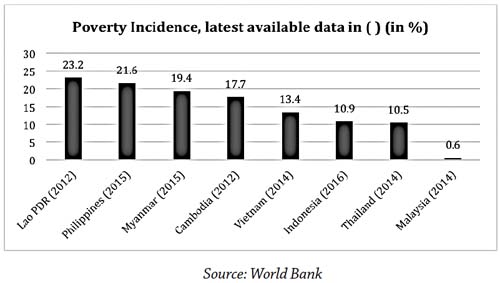
The figure below presents the poverty incidences of Association of Southeast Asian Nation member-countries with available data. These are measured based on the percentage of individuals living below the designated national poverty line for each country. The Philippines is shown to have one of the highest poverty incidences in the region, next to Lao PDR and followed closely by Myanmar. Meanwhile, countries which share similar economic characteristics with the Philippines, namely, Indonesia and Thailand, have significantly lower levels of poverty incidence. Hence, while the Philippines has been successful in reducing its poverty incidence during the past few years, it still faces the challenge of being on par with its neighbors, particularly those countries that it shares similar characteristics with.
One of the government’s prominent poverty-related programs is the Conditional Cash Transfer Program, otherwise known as the Pantawid Pamilyang Pilipino Program, or 4Ps. This program aims to jointly alleviate short-term poverty and break the cycle of intergenerational poverty by providing selected households with cash grants if they meet certain conditions. These conditions include ensuring that children consistently attend school, as well as receive health checkups and vaccines. Pregnant women must also avail of prenatal and postnatal care, and be assisted during childbirth by a trained health professional. In addition, parents must attend family-development sessions to learn about positive child discipline, disaster preparedness and women’s rights.
The rightmost column in the table below displays the provinces with the most number of household beneficiaries in 2015. It is juxtaposed alongside the provinces that have the highest number of poor families during the same year. A cursory review of this table suggests that there is a slight mismatch between these two sets of data. Maguindanao has the highest number of targeted household beneficiaries, at 200,537. However, poverty statistics from the PSA indicate that a lower number of 86,100 poor households reside in the province. Sulu also has a significant number of 4Ps household beneficiaries, at 107,368, even though the province registers a lower number of poor families compared to other provinces at 83,289. In contrast, provinces that have a larger magnitude of poor households obtain lower coverage in the 4Ps program. To illustrate, although Cebu has the largest number of poor families, at 179,162 based on data from the PSA, the 4Ps targets a lower magnitude of 129,986 poor families in the province.

What has Been Done So Far? (by others)
Minimum wage laws
Minimum wage laws require all employers to pay their employees a minimum amount of wage that is determined by the government. The idea behind minimum wage laws is to help the working poor without directly increasing government spending. Labor unions are some of the most influential advocates of minimum wages. They often try to establish a minimum wage for their members.
However, minimum wage laws are highly controversial. Critics argue that they essentially hurt an economy more than they help. This argument is based on the law of supply and demand. If the minimum wage increases above the equilibrium wage, employers can’t afford to hire the same amount of workers anymore. Hence, unemployment increases. As a result, those who are still employed are indeed better off because they profit from a higher wage. But at the same time the increase in unemployment will put even more people at risk of poverty.
Whether the effects if the employee’s higher incomes outweigh the increase in unemployment ultimately depends on the elasticity of labor demand. Advocates of minimum wages argue that labor demand is inelastic (i.e. it will not decrease much) while critics say it is elastic (i.e. it will decrease significantly). Especially in the long run, when firms can adjust their factors of production more freely.
Social Security
Social security refers to a number of different government benefits, such as income support, tax credits, social welfare or unemployment benefits. A countries social security system is another option the government has to reduce poverty by supplementing the incomes of poor families and individuals.
Again, social security is an complex issue. However, most people agree that any government should provide at least a basic social security system (i.e. a “security net”) to prevent people from falling too deep into poverty. In most cases, those people who qualify for social security will still experience a difficult existence at best. Therefore, it is widely regarded as unlikely that many people would be encouraged to pursue such a lifestyle anyways.
Negative Income Tax
Negative income taxes are essentially a subsidy for individuals with a low income (i.e. they pay a negative tax). This works well in a progressive tax system, where individuals with a higher income also pay a larger percentage of their income in taxes. A part of those additional tax revenues can be used to subsidize individuals and families with a low income.
Many economists consider this a good option to redistribute wealth within a country. According to this system poor individuals and families receive financial assistance depending solely on their income. However, this can be seen as an advantage or a disadvantage. On the one hand, it does not incentivize certain unfavorable lifestyles (such as getting a divorce to increase income support). On the other hand it may also support people who are simply to lazy and unwilling to work.
In-Kind Benefits
In-kind benefits are a non-cash alternative to regular benefits. The idea behind this is to provide poor families and individuals directly with access to certain goods and services they need most in order to increase their standard of living. For instance, there are a large number of charities (government and non-government) that provide food, shelter, or clothing for those most in need.
Advocates of in-kind benefits argue that this type of support ensures that the poor really get access to what they need most. They also prevent recipients from using government benefits to buy undesirable products and services (e.g. drugs or alcohol). On the other hand, critics argue that non-cash benefits are inefficient and disrespectful. They point out that in-kind benefits essentially deprive the poor of their right of decision. According to the critics, the government does not always know what people need most, so it has no right or obligation to decide for them.
In a Nutshell
Poverty is a problem everywhere in the world and governments play an important role in the fight against it. They can employ at least four different policies to reduce poverty: minimum wage laws, social security, negative income taxes, and in-kind benefits. Minimum wage laws require all employers to pay their employees a minimum amount of wage that is determined by the government. Social security refers to a number of different government benefits, such as income support, tax credits, social welfare or unemployment benefits. Negative income taxes are essentially a subsidy for individuals with a low income. And last but not least, in-kind benefits are a non-cash alternative to regular benefits.
Why the Group’s Solution is Better? What is your Value Proposition to those Affected by the Issue?
With the new government now in place, the demands are sure to start coming soon that Harper tackle the persistent problem of poverty. And there’s no dearth of suggestions of how to “make poverty history”: increase the minimum wage, increase welfare payments, create more make work projects, and let’s get more rent control.
When we talk about poverty like this, though, we’re talking about it as if it’s a virus, lurking around a corner, ready to randomly infect whomever happens to saunter by. But poverty is not random. I know it’s not socially acceptable to say it, but poverty tends to stalk those people who have behaved in ways that make earning a good living more difficult.
Obviously there will always be factors beyond our control, and I hope that Harper implements good economic policies that will relieve the kind of poverty that stalks communities when industry dries up. Too often, though, we’re scared to talk about the personal factors in poverty because it sounds like we’re blaming people. But we have to talk about it if we want to help young people steer clear of poverty’s pitfalls. Those of us who are parents can and should focus on poverty prevention among our kids, since we may hold the keys that the government can’t reach.
While you’re busy looking for those jobs, there’s something you shouldn’t be doing: having a baby. Wait until you are married. Single parenthood is the biggest ticket to poverty there is. Marriage, on the other hand, often acts as a “get out of poverty free” card. Linda Waite and Maggie Gallagher, in a large-scale study of marriage, found that marriage itself tends to boost one’s income potential. So if you can, steer clear of losers and abusers, find someone stable and kind to marry (I know that’s the hard part), stay married, and wait until you’re married to become a parent.
Finally, stay out of trouble. If you’re in jail, it’s hard to feed your family, and it’s hard to get a job afterwards.
These steps aren’t rocket science, and on the surface they aren’t that difficult. But they’re not that fun, and that’s probably why this advice is often spurned. Many young people suffer from what Galston calls a “magical outlook”: ask them what they’ll be doing ten years from now, and they talk about having a nice house, a great entertainment system, a fancy car, trips to the Caribbean, and more, but they don’t do anything in the here and now to give this a chance of happening. Our kids are taught to dream, but not to do.
Let’s teach them to do. It’s not hard, so let’s say it together: finish high school. Take a job. Don’t have a baby without getting married. Marry wisely. Stay out of trouble. And that’s it. Of course, you probably will still experience rough times, and there are no guarantees. People you love can leave you. You still have to be careful with credit cards, with savings, with spending. But these steps offer you as close to a clear future as anything else we’ve come up with. So don’t ridicule it. Just do it, and make poverty history.
Why You Need People’s Support in Your Project/Proposal? What can People Do to Help You?
The people directly affected by the problems or issues of poverty in the community have to be actively and authentically participating in the efforts to fight poverty. This means that the affected people themselves will be the major participants of the intervention to fight poverty. Not only the formal leaders need to be consulted, but also the affected themselves. Their worldview and situation should be taken into consideration and through facilitation they become part of the process of addressing and resolving their problems.

Create an organized group within the community to help many people rather than working with a few individuals. Rather than working with individual persons, it is more effective to facilitate collective and organized actions to help strengthen and empower people in poverty through an organization. This means that it is not enough to provide assistance to individually affected persons alone but through a collective organization each individual is developed and steps are taken to address their problems and other problems in the future. The people affected need to identify the issues. It is more effective when issues and problems are identified by the people. They then begin to gain self-confidence and acquire capabilities in working together on simple issues and problems. This means that their initial efforts and experience can be used towards addressing more complex problems and issues. It is in identifying and acting on their initial simple issues or problems that the affected people gain their self-confidence and capability to identify other issues or problems which need to be addressed. Though externally, well thought introduced projects can help fight poverty, without the people’s active involvement and linking these projects with their own situation, identified issues and problems, such projects will most likely not be sustained. People in poverty need to understand that they can often address and solve their own issues. The affected people going through the process of fighting poverty should have a raised level of consciousness about their situation and their capabilities in order to sustain their collective efforts and also to address other issues and problems. Fighting poverty takes time. The process of fighting poverty is not a simple and short–termed process, especially if we want a deep transformation to take place to those affected. It takes time to enable and facilitate the affected people so they can break the “culture of silence” and become actors of their own development.
Infographics – a visual view of the above (from what your group is up to why you need people’s help)

Images/Videos – that can support your blog, don’t forget to give credits

 ICTandME